
Have you ever thought about setting out on a journey that comforts your heart and brings peace to your soul? Before going on this sacred journey, you need to understand the meaning of Umrah. Umrah is the voluntary pilgrimage that Muslims can take to the holy city of Makkah at any time of the year, unlike Hajj. Hajj is the obligatory pilgrimage to Makkah that you have to perform once in your lifetime if you are financially and physically able. You can only perform Hajj on specific days of Dhul-Hijjah.
Going for Umrah is not just a trip to holy sites and performing rituals; it's a path that changes your life for the better. Now close your eyes and imagine opening them and seeing the Kaaba for the first time. The tear that wells up in your eyes is the sign that you are at home, and that home is the Kaaba, where broken hearts and souls are healed from the trauma they carry for years. When you raise your trembling hands to ask for His mercy and beg for forgiveness, you feel like you are talking to your Lord and He is only listening to you. The true meaning of Umrah is basically connecting with your God.
The Arabic word "Umrah" means "to visit" or "to make a journey to a populated place." Umrah is the mini version of Hajj and is often called a lesser "pilgrimage". If you see it in Islamic terms, it is a memorable trip that millions of Muslims take to the Holy city of Makkah and perform specific rituals. It involves visiting the Sacred Mosque (Masjid al-Haram) in Makkah and performing particular rituals:
The Prophet Muhammad (PBUH) said:
"The performance of) Umrah is an expiation for the sins committed between it and the previous one."
(Sahih al-Bukhari, 1773; Sahih Muslim, 1349)
Ibadah is more than just performing rituals; it brings immense blessings and rewards that give you peace, cleanse your soul and purify your heart.
You can perform Umrah at any time you want throughout the year except during Hajj days. And the interesting part? It can be done in a shorter period of time, usually 3-6 hours, depending on you and the crowd conditions. There are basically two types of Umrah:
Simply put:
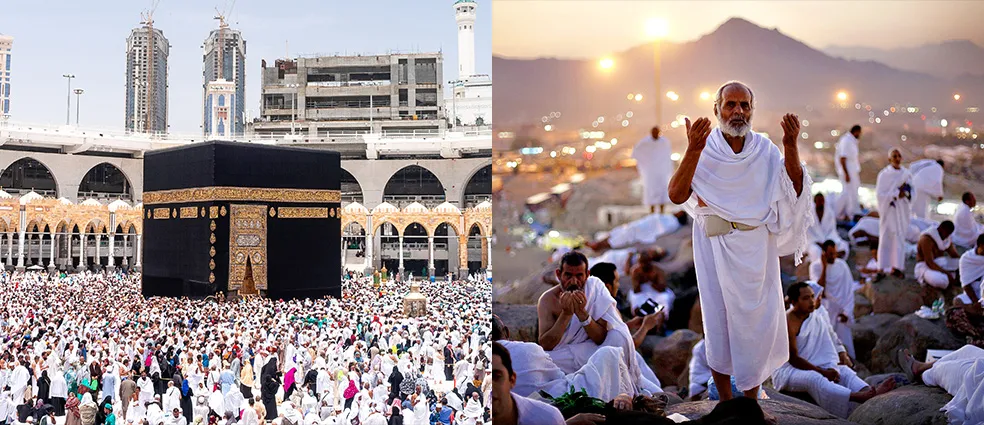
Although you have to go to Makkah for both Hajj and Umrah, they are not the same; they have many key differences.
| Aspect | Umrah | Hajj |
| Obligation | Recommended (Sunnah Mu’akkadah) | Mandatory (one of the five pillars of Islam) |
| Timing | Can be performed anytime during the year | Performed only during specific days of Dhul-Hijjah |
| Duration | Usually takes a few hours | Lasts several days (5-6 days) |
| Rituals | Ihram, Tawaf, Sa’i, shaving/trimming | Includes Umrah rituals plus Arafah, Muzdalifah, Mina, stoning of pillars, sacrifice, etc. |
Umrah does not take long, but it is essential for Muslims. Many people go more than once in their lives to show their love for God and feel strong in their faith again.
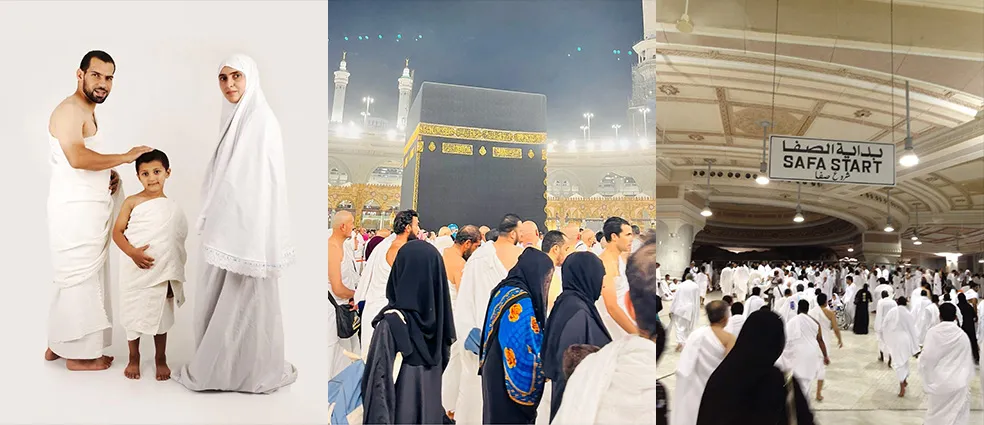
There are four simple things you do to complete Umrah. Each part has a special meaning that connects the person praying directly to God and to the long history of the Muslim faith.
Entering the state of Ihram is like entering the state of purity, and it starts long before entering Makkah. It begins with your intention (Niyyah) when you decide in your heart to perform Umrah, and this counts as an act of worshipping God. This intention is like the spiritual key that makes every moment of the journey an act of devotion. When pilgrims enter the state of Ihram, they recite Talbiyah:
"Labbayk Allahumma Umrah"
("Here I am, O Allah, to perform Umrah.”)
This is the moment regular life stops, and the pilgrims completely give themselves over to Allah. Everyone feels more and more excited and ready as they travel toward Makkah.
The Qur'an reminds believers:
"Indeed, the most noble of you in the sight of Allah is the most righteous of you."
(Surah Al-Hujurat, 49:13)
When pilgrims complete each circle, they remind themselves of Allah. They keep walking and say a prayer, ask for forgiveness, and think about how great Allah is. Performing Tawaf doesn't mean just walking around the Kaabah, it holds a deeper meaning. This walking shows that a believer gives their whole life to Allah (SWT), who is the centre of everything for them.
The Qur'an says:
"And let them circumambulate the ancient House."
(Surah Al-Hajj, 22:29)
With the completion of each circle, pilgrims remind themselves of Allah. As they walk, they say a prayer, ask for forgiveness, and think about how great Allah is. The Tawaf also reminds us of Prophet Ibrahim (AS) and his son Ismael (AS) and connects us with the tradition they started.
The next step to perform Umrah after Tawaf is to do Sa'i. This means you have to walk or gently run seven times between the small hills of Safa and Marwah. This is not just a random act of walking or running; this reminds us of the story of Patience of Hajar, the wife of Prophet Ibrahim (AS). She ran desperately between the hills of Safa and Marwah in search of water for her son, Ismael (AS).
The Sa'i teaches us to keep trying (persistence), to trust entirely in God (Allah), and to rely on Him. It shows us that when we put in sincere effort and have strong faith, Allah's kindness will come. This kindness is perfectly demonstrated by the Zamzam appearing right when Hajar needed it most.
Allah mentions this act in the Quran and Honours it:
"Indeed, Safa and Marwah are among the symbols of Allah. So whoever makes Hajj to the House or performs Umrah, there is no blame upon him for walking between them."
(Surah Al-Baqarah, 2:158)
The very last step of your Umrah is called Halq (shaving) or Taqsir (trimming) of your hair.
This small act officially finishes the Umrah. It's a physical way of saying you are starting fresh—a symbol of renewal and humility (being modest) before Allah. It's like a fresh start for your heart and soul after completing this sacred journey.
The Prophet (PBUH) prayed for those who shave their heads:
May Allah have mercy on those who shave (their heads). The companions asked: "And those who shorten it, O Messenger of Allah?" He said: "And those who shorten it."
(Sahih al-Bukhari, 1727; Sahih Muslim, 1301)
Umrah is not just a set of steps; it's a change for the heart. Many pilgrims share their experiences of feeling more peaceful, humble, and having a clear, fresh mind after performing Umrah. The real spiritual cleansing starts with the journey itself; don't bother about what people do and may not do at the Kaaba. Focus on your own spiritual journey, try to humble yourself, and try to defeat your nafs. Don't try to find a solution outside of yourself to internal problems.
Doing Umrah strengthens your spirit in several ways. The journey makes you patient as you handle delays and crowded areas. Standing at the Kaaba encourages deep thankfulness, making you realise the blessing of the trip. And the commitment to prayer and self-control helps you build lifelong discipline.
Above all, Umrah is about saying sorry and starting over. Being in the Holy Mosque reminds you that you rely on Allah and that this world is temporary. It gives you an excellent opportunity to ask for forgiveness and choose a life with a greater, better purpose.
The Prophet (PBUH) said:
Follow up between Hajj and Umrah, for they remove poverty and sins just as the bellows remove impurities from iron."
(Sunan al-Tirmidhi, 810)
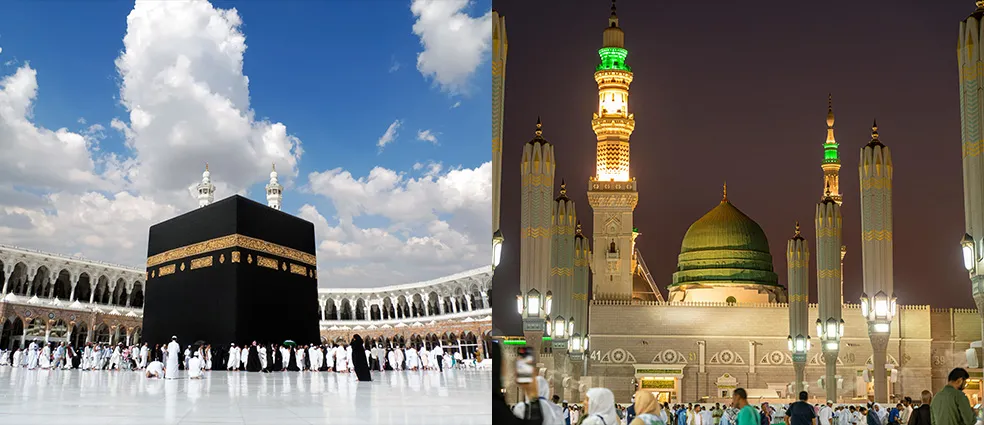
If you think Umrah is the name of performing some rituals, it's not! When you enter Makkah, you feel close to Prophet Muhammad (PBUH) and the great history of Islam's very first followers. When pilgrims perform Umrah, in the back of their mind, they know that they are following the exact path of Prophet Ibrahim (AS) and Prophet Ismael (AS), who built the Kaaba as Allah's House. When they perform Tawaf, Sa'i, or shave their heads, they are taking part in a history that has lasted for thousands of years.
After performing Umrah, many Muslims also go to Madinah, which is the city of the Prophet Muhammad (PBUH). Madinah is the city of peace and love. When you are standing at Rawdah Rasool, and praying in Masjid an Nabwi, it reminds a believer of how humble, patient, and kind our Prophet was, and encourages us to follow his exact path. Just being in Madinah, seeing the places he knew, and walking where he walked and feeling the calm of the city can make your love for him and his message much stronger. Visiting both Makkah and Madinah gives you a complete trip of respect, quiet thought, and spiritual restart.
If you ask a Muslim what their biggest wish is, they'll most probably say going to Allah's House (Kaaba) and performing Umrah is at the top of their Bucket list. It's a lifelong dream and for some takes years of saving money, waiting patiently and making dua after every prayer to reach Makkah. When they reach Makkah, seeing the Kaaba with their own eyes is something that sticks in their memories for the rest of their lives. They offer Nafal of gratitude there and thank Allah (SWT) for accepting their dua to be in His House. The Prophet (PBUH) told us that if you make dua in Haram, Allah is most likely to say yes to your prayer.
The Prophet (PBUH) said:
One prayer in my mosque is better than a thousand prayers anywhere else except Al-Masjid al-Haram. (Sahih al-Bukhari, 1190; Sahih Muslim, 1394)
Because of this, pilgrims pray for various things, such as forgiveness for mistakes, help in life choices, good health, and happiness for their loved ones. Some experience that their wish comes true immediately, sometimes in ways they never expected! But it's not just about asking for things you want in the world. The real purpose of making dua during Umrah is to deepen your bond and trust with Allah. It reminds you that He hears you, knows everything, and will answer in the best way and at the perfect moment.
Planning your Umrah means you must prepare both your mind/spirit and your body for Umrah. Spiritually, you need to:
Umrah is physically demanding, and you need stamina. It means lots of walking, dealing with the crowds, and sometimes, when it's very hot, it can be exhausting. The key to a good experience is simple: keep your health up, stay hydrated (drink water), and make sure you get enough sleep.
Umrah is a profoundly emotional trip, and dealing with travel problems can easily distract you from worshipping. Don't worry, planning your Umrah with Makkah Travel is easy. Our Umrah packages make the entire journey stress-free so you can focus entirely on worship and reflection.
When a professional handles the travel details, you feel stress-free. You can use all your time for prayer and gratitude. Makkah Travel removes the burden so you can be fully present in every moment of Umrah, saying your prayers, thinking about your life, and feeling the sacred power of the holy cities.
Umrah is a journey for the soul, not just the body. It teaches us humility, equality, and submission. From the moment you begin until the final prayer, you are constantly reminded of the great mercy and power of Allah. For many people, Umrah is a spiritual turning point, a total fresh start filled with forgiveness and a more explicit purpose. By picking reliable help, like Makkah Travel, you can forget about the boring travel details and focus entirely on worship and reflecting on your lives.
In the end, a successful Umrah is not judged by how easy the trip was, but by how much it changed your heart. That's why people often say Umrah Mubarak, meaning "may your Umrah be blessed." It's a way of wishing someone blessings for this sacred journey and hoping it brings them closer to Allah.
When a believer goes back home with more peace, thankfulness, and faith, they have truly fulfilled the real purpose of the pilgrimage.
The real meaning of Umrah is "to go", or "to visit a populated place". In Islam, Umrah is a journey that you can take at any time of the year to the holy cities of Makkah and Madinah to cleanse your soul and seek forgiveness. It is also called a lesser or minor pilgrimage.
The key spiritual role of Umrah is to seek the forgiveness of Allah, one way of getting closer to him and renewing your faith. It is the act that demonstrates that we are submissive, and we are entirely submitted.
Umrah is a spiritual reset button for Muslims. It reminds them of their primary life goal and the significance of being followers of Allah. People come back feeling a stronger faith, more thankful, and ready to live a good, right life.
Yes, Umrah is mentioned in the Quran with Hajj in Surah Al-Baqarah (2:196). We also learn how to do it and its rewards from the many teachings (Hadith) of the Prophet Muhammad (peace be upon him).
Umrah is the voluntary pilgrimage that you can take to Makkah whenever you want. Hajj is obligatory if you are physically and financially able to take this journey and can only be performed on the specific days of Dhul Hijjah.
Yes, the Prophet Muhammad (PBUH) said that if you complete your Umrah, it erases the minor mistakes and sins you made since your last Umrah. The one condition that applies is that you must stay away from the major sins.
People who are in front of the Kaaba have a profound feeling of peace and humility (they are tiny before God). It's a highly emotional time used for quiet thinking (reflection), saying sorry for mistakes (repentance), and feeling very thankful.
Yes. A Muslim can do Umrah for someone else who can't go, either because they have died or are too sick/disabled. The main rule is that you must have already done your own Umrah trip first. This act is called Umrah Badal and Proxy Umrah.
Because for a believer, Umrah offers a fresh start, the Umrah rituals symbolise cleansing the heart, lowering the burden of past mistakes and a way to renew one's commitment to Allah.
There is no set limit. A Muslim can perform Umrah as often as they are able, provided it is done sincerely and within their means.
 SVG.svg)
Makkah Travel is here to help you visit religious places.

 Arrow SVG.svg)
 SVG.svg)