
After the Azan finishes, there is a special dua that Muslims are taught to recite. This dua is short, but it carries great reward and meaning. It is a Sunnah taught by Prophet Muhammad PBUH. So it is very important to learn and make it part of your daily routine.
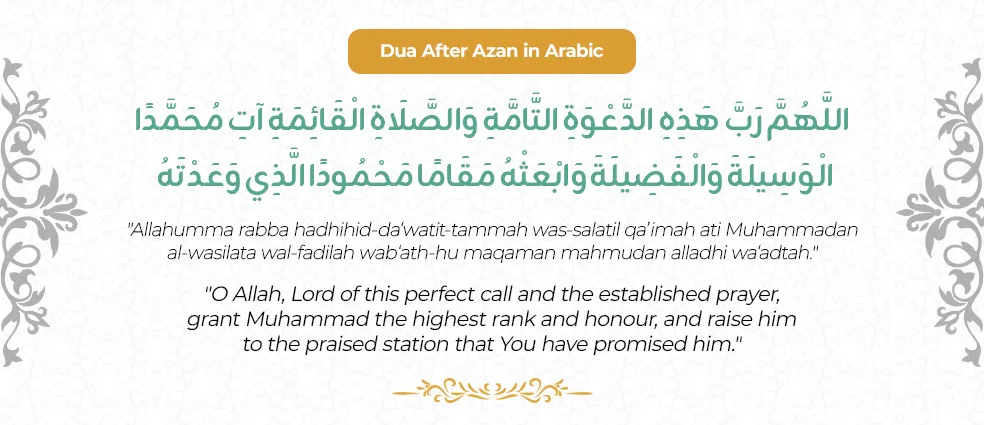
اللَّهُمَّ رَبَّ هَذِهِ الدَّعْوَةِ التَّامَّةِ وَالصَّلَاةِ الْقَائِمَةِ آتِ مُحَمَّدًا الْوَسِيلَةَ وَالْفَضِيلَةَ وَابْعَثْهُ مَقَامًا مَحْمُودًا الَّذِي وَعَدْتَهُ
"Allahumma rabba hadhihid-da‘watit-tammah was-salatil qa’imah ati Muhammadan al-wasilata wal-fadilah wab‘ath-hu maqaman mahmudan alladhi wa‘adtah."
This helps people who cannot read Arabic recite the dua correctly.
"O Allah, Lord of this perfect call and the established prayer, grant Muhammad the highest rank and honour, and raise him to the praised station that You have promised him."
Try to memorise this dua and read it every time you hear the Azan. It only takes a few seconds, but it can bring great blessings in your life.
The dua after Azan may be short, but every word in it has a deep and powerful meaning. When you understand what you are saying, your connection with the dua becomes stronger and more sincere.
Let’s break it down simply so it is easy to understand.
In simple words, this dua is about asking Allah to honour the Prophet PBUH in the best way. At the same time, it also rewards the person who recites it.
Hearing the Azan is not just about knowing that it is time for Salah. It is also a chance to earn rewards by following a few simple Sunnah steps. These actions are easy to do, take only a few minutes, and bring great blessings if done with attention and sincerity.
When the person calling the Azan (Mu’adhin) recites the call to prayer, you should quietly repeat the same words after him. This helps you stay focused and connected to the message of the Azan.
There is one small difference. When you hear:
You should say:
لَا حَوْلَ وَلَا قُوَّةَ إِلَّا بِاللّٰهِ
La hawla wa la quwwata illa billah
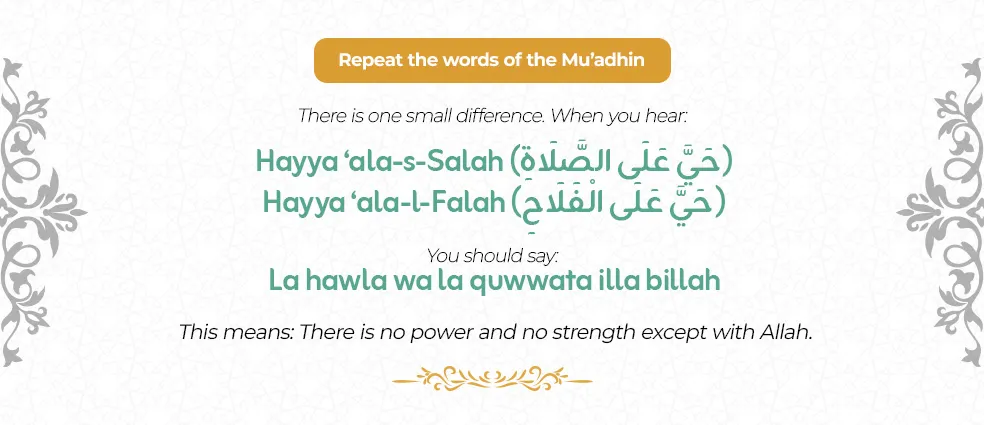
This means: There is no power and no strength except with Allah.
After the Azan finishes, the next step is to send blessings (Durood) upon Prophet Muhammad PBUH. This is also a Sunnah and brings great reward.
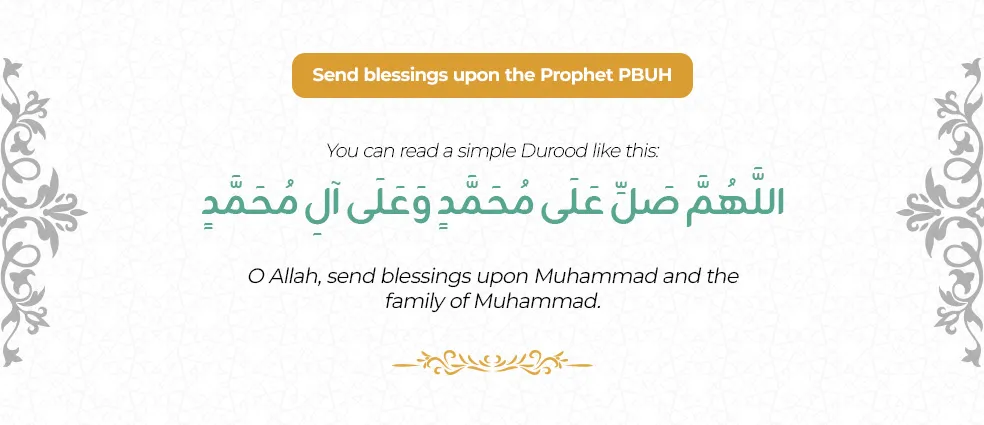
You can read a simple Durood like this:
اللَّهُمَّ صَلِّ عَلَى مُحَمَّدٍ وَعَلَى آلِ مُحَمَّدٍ
Meaning:
O Allah, send blessings upon Muhammad and the family of Muhammad.
Sending blessings shows love and respect for the Prophet PBUH and increases your rewards.
After sending Durood, you should read the special dua after Azan. This is the dua taught by the Prophet PBUH, asking Allah to give him the highest rank and honour.
This step completes the Sunnah actions after the Azan. Even though it is short, it is of great importance and offers great reward.
Not everyone finds it easy to memorise long duas straight away. That’s completely okay. Islam is simple, and even small efforts are valued. If you are still learning, you can start with a shorter dua after the Azan and slowly move towards the full version.
Here is a short and easy dua that some people recite:
Arabic:
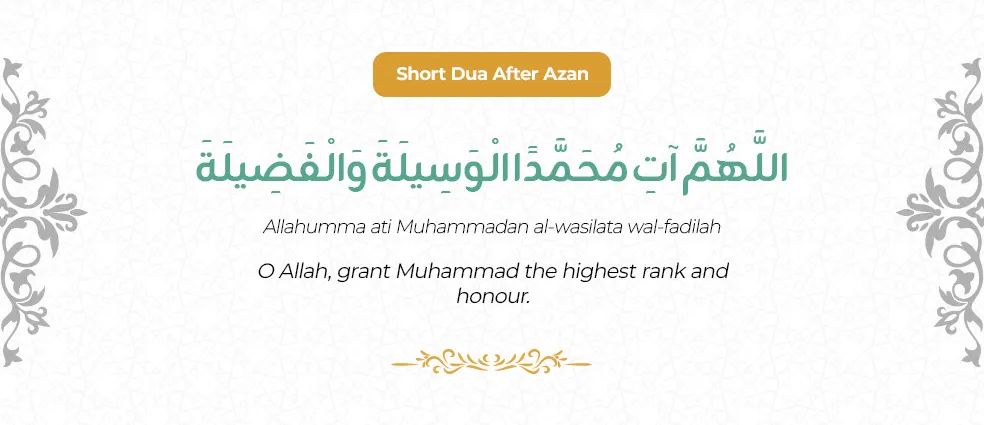
اللَّهُمَّ آتِ مُحَمَّدًا الْوَسِيلَةَ وَالْفَضِيلَةَ
Transliteration:
Allahumma ati Muhammadan al-wasilata wal-fadilah
Translation:
O Allah, grant Muhammad the highest rank and honour.
Even though this shorter version is good and brings rewards, it is better to learn and read the full dua mentioned in authentic Hadith. The full dua includes more complete words and greater meaning.
After hearing the Azan, many people wait for the prayer time to begin. But Islam teaches us that this short moment is very special. If you use it wisely and recite the dua after Azan, you can gain many rewards from Allah.
One of the greatest rewards of this dua is that it can help you receive the intercession of Prophet Muhammad PBUH on the Day of Judgment. This means the Prophet PBUH will ask Allah to forgive and help those who follow this Sunnah. For a believer, this is one of the highest hopes and greatest honours.
When you recite the dua after Azan, you are following the way taught by Prophet Muhammad PBUH. Following Sunnah brings you closer to Allah and makes your daily life full of blessings. Even a simple action like this shows love and respect for the teachings of Islam.
Every time you remember Allah and follow a Sunnah, you earn a reward. The dua after Azan is very easy to read, but the reward for it is very great. It is a simple habit that can increase your good deeds every single day, especially if you read it after every prayer call.
Reciting this dua helps you stay spiritually connected. It reminds you that Salah is not just a routine, but a direct link with Allah. When you respond to the Azan with remembrance and dua, your heart becomes more focused, and your faith becomes stronger over time.
Lastly, this dua takes only a few seconds, but its effects are long-lasting. It builds discipline, increases awareness of prayer, and keeps you connected to your religion throughout the day. Small, consistent actions like this help shape a strong Muslim character.
After the Azan ends, many people think that only a fixed dua should be read and nothing else. But in Islam, this is actually a very special time when you are allowed and even encouraged to make your own personal prayers to Allah.
This short period between the Azan and the start of prayer (Iqamah) is a blessed moment. It is a time when a Muslim is still spiritually connected, calm, and focused on Allah. Because of this, it becomes a very powerful time to ask for anything from Him.
As taught by the Prophet Muhammad PBUH, the time between the Azan and Iqamah is a moment when supplications are accepted, not rejected. This means Allah is especially close at this time and listens to every sincere prayer.
So after you complete the recommended dua after Azan, you are free to speak to Allah in your own words. You do not need to use any special language. You can ask Him whatever is in your heart.
After the Azan finishes, there is a special waiting time before the Iqamah is called. This brief gap is very valuable in Islam because it is a peaceful moment when a person is still connected to prayer time but has not yet stood in Salah.
The time between Azan and Iqamah is one of the best times of the day to ask Allah for your needs. You can make any halal (permitted) dua during this time. There is no limit or fixed wording for personal supplication.
You can ask for things like:
This is a simple but powerful opportunity. Many people miss it because they think it is just waiting time, but in reality, it is a moment of acceptance.
The Prophet Muhammad PBUH explained that there are special moments when Allah accepts duas more easily, and the time between Azan and Iqamah is one of them. This means your prayer during this short period carries great hope and value.
A good way to spend this time is:
This short period may look small, but it is full of reward. It is a chance to build a strong connection with Allah before standing in Salah. Many scholars remind Muslims not to ignore this time.
The dua after Azan is a small but very powerful act of worship. It does not take much time, but it brings great reward and blessings from Allah.
By reading it after every Azan, a Muslim shows love and respect for the call to prayer and follows an important teaching of Islam.
Try to make this a regular habit in your daily routine. Every time you hear the Azan, stop for a moment, respond to it, and read this simple dua. Small actions like this can bring big rewards in this life and the next.
The dua after Azan is a short supplication taught by Prophet Muhammad PBUH. It is recited after the call to prayer and asks Allah to give the Prophet PBUH a high rank in Paradise and honour.
The recommended dua is the one mentioned in authentic Hadith. It is recited after the Azan ends and after sending blessings on the Prophet PBUH. It is simple, short, and full of reward.
The main reward is that a person can receive the intercession of Prophet Muhammad PBUH on the Day of Judgment. This is a very big honour for every Muslim.
Yes, you can make personal duas after Azan. The time between Azan and Iqamah is blessed, and Allah accepts prayers made during this time.
 SVG.svg)
Makkah Travel is here to help you visit religious places.

 Arrow SVG.svg)
 SVG.svg)